

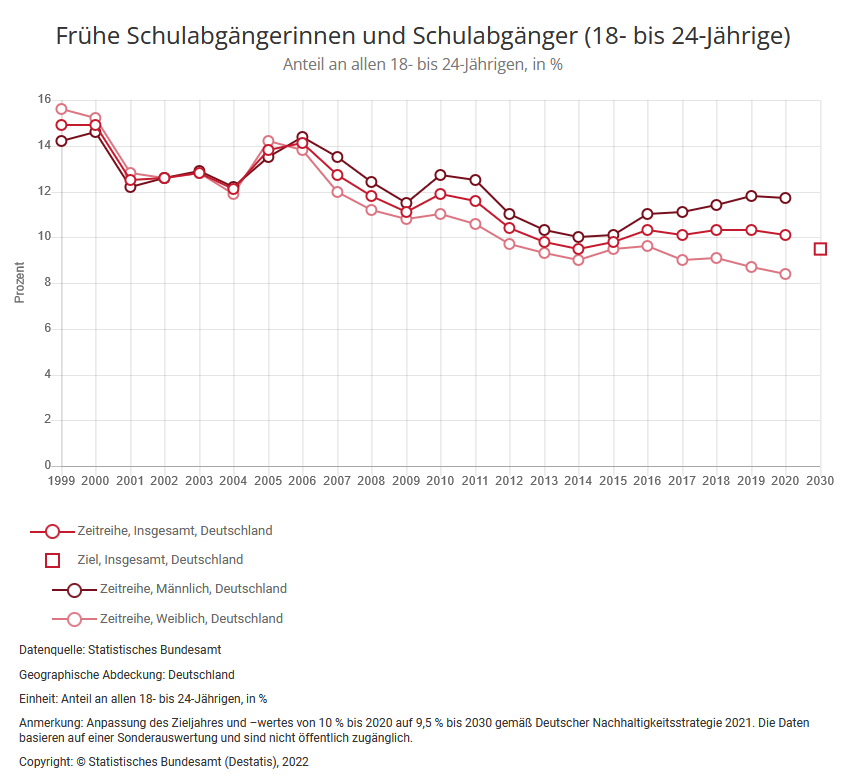
How has the proportion of early school leavers developed?
Further information on this indicator
-
The indicator shows the proportion of all persons in the same age group aged 18 to 24 who are not currently attending school or college, are not participating in any continuing education program and have not completed upper secondary education (university entrance qualification or completed vocational training). This is not to be confused with school dropouts. Rather, it refers to people between the ages of 18 and 24 who have neither a higher education entrance qualification such as an Abitur or Fachhochschulreife nor completed vocational training, and who are also not participating in education and training measures. This means that young people who have successfully completed secondary school, for example, but are no longer in the education process, are also counted as early school leavers. The indicator thus covers people both without and with a lower secondary school leaving certificate who are not continuing their education. The lack of school-leaving and vocational qualifications means a risk of poverty and a burden on the social systems.
-
The German government has set a target of reducing the proportion of early school leavers to 9.5% by 2030.
-
For indicators without a set baseline by the German Sustainability Strategy, 2030Watch uses the 2008 baseline of the EU2020 Strategy.
-
This is an official indicator of the German Sustainability Strategy.