
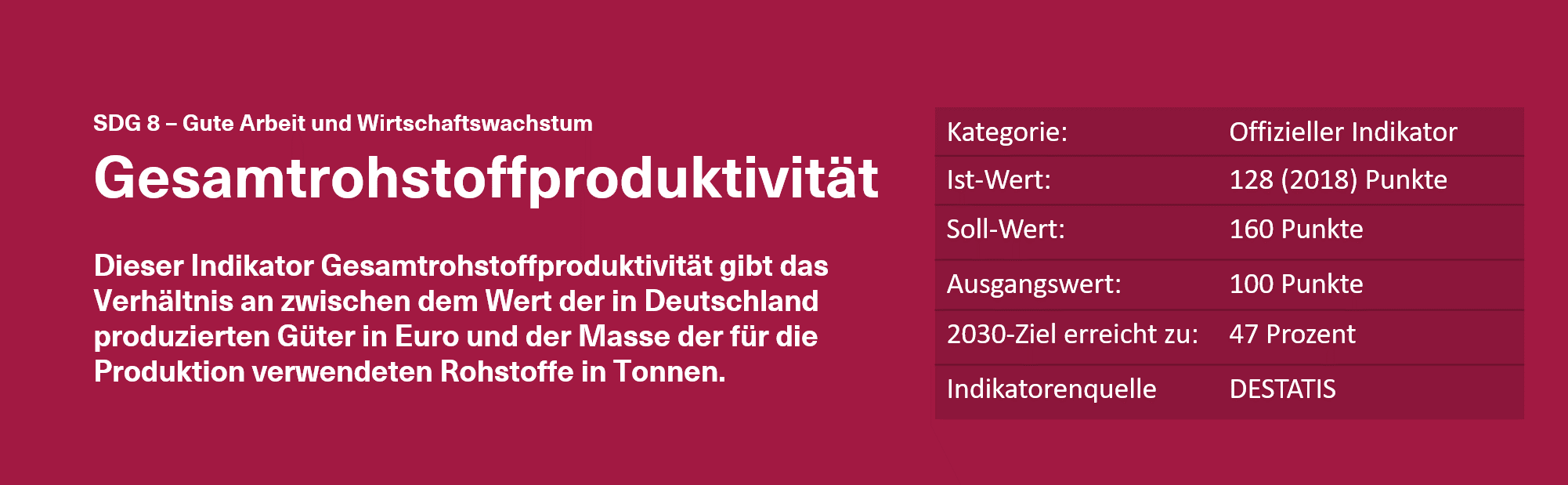
How has overall raw material productivity developed?
Further information on this indicator
-
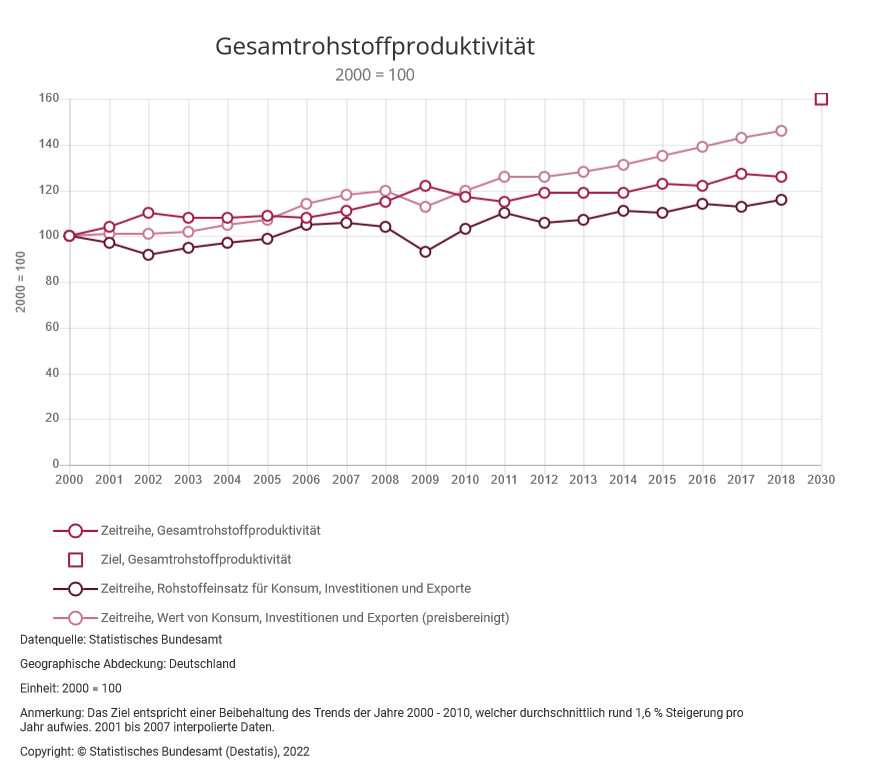
Primary raw materials are limited and their extraction often has a significant impact on the environment. According to the Federal Environment Agency, it is therefore an objective of German environmental policy to use raw materials as efficiently as possible. The indicator described here measures the value of all goods in euros (price-adjusted) in relation to the mass of raw materials that were necessary to produce these goods, in tons. Only goods that are transferred to their final use are taken into account, i.e. goods that are used in the production of other goods are excluded. The indicator takes into account goods for domestic consumption, domestic investment and goods for exports. All domestic and foreign commodities are included in the calculation. This indicator is also part of the German Resource Efficiency Program (ProgRess) II of the Federal Government. As the indicator also includes raw material use for exports, the indicator should not be confused with Germany's raw material footprint. The data are provided by the Federal Statistical Office.
-
Based on the development between 2000 and 2010, the German government is aiming for an annual increase in raw material productivity of at least 1.5%. In the years 2000 to 2010, total raw material productivity already increased by an average of around 1.6% per year. Such a positive trend is to be continued until 2030. Assuming an average annual increase of 1.6% from 2011, the figure for 2030 is 160%.
-
The initial value is 100 for the year 2000, which was chosen as the reference year.
-
This is an official indicator of the German Sustainability Strategy.