

How has the emission load developed?
Further information on this indicator
-
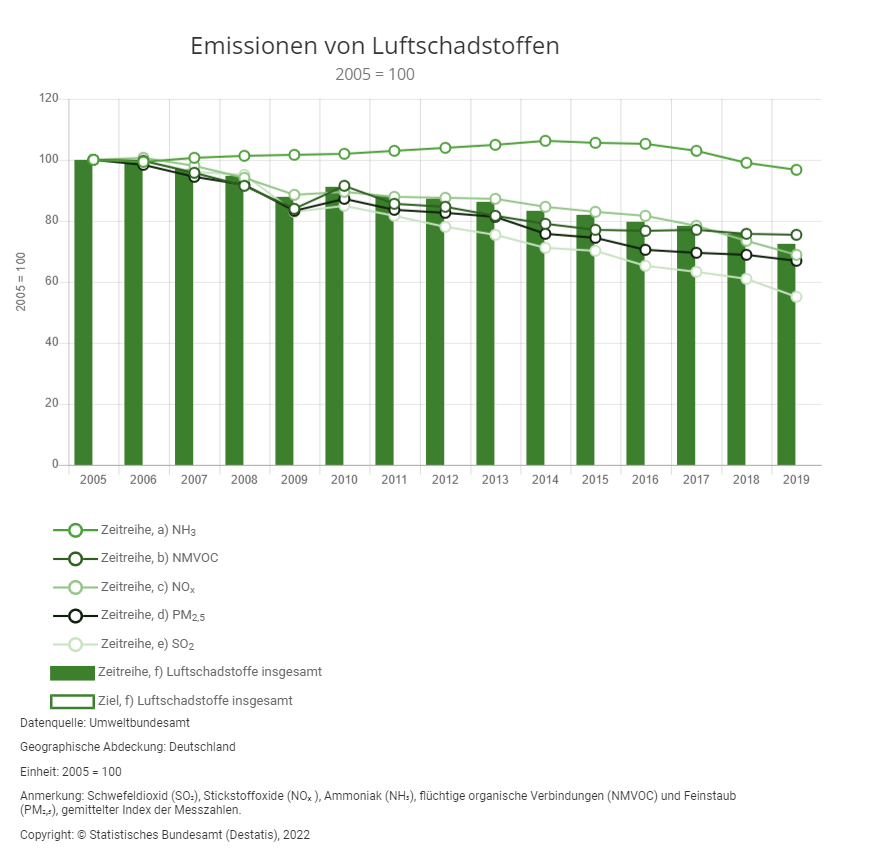
The indicator represents the mean value of the indices of national emissions of the five air pollutants sulfur dioxide (SO2), nitrogen oxides (NOx), ammonia (NH3), volatile organic compounds (NMVOC) and particulate matter (PM2.5). Under the National Emission Reduction Commitments (NERC) Directive negotiated at the European level, Germany is to reduce emissions of each air pollutant by 2030 as follows: SO2 by 58 percent, NOx by 65 percent, NH3 by 29 percent, NMVOC by 28 percent and PM2.5 by 43 percent. Based on this, the Federal Environment Agency calculated an unweighted, arithmetic mean of the individual reductions of the air pollutants mentioned as a target value. The data are calculated annually by the Federal Environment Agency using various sources. They serve as the basis for the reporting obligation under the Geneva Clean Air Convention for long-range air pollutants and the NERC Directive.
-
The German government has set a target of reducing emissions of air pollutants by 45 percent by 2030 compared with 2005 levels.
-
The value of the year 2005 was defined as the initial value with 100%.
-
This is an official indicator of the German Sustainability Strategy.