

How has the nitrogen content developed?
Further information on this indicator
-
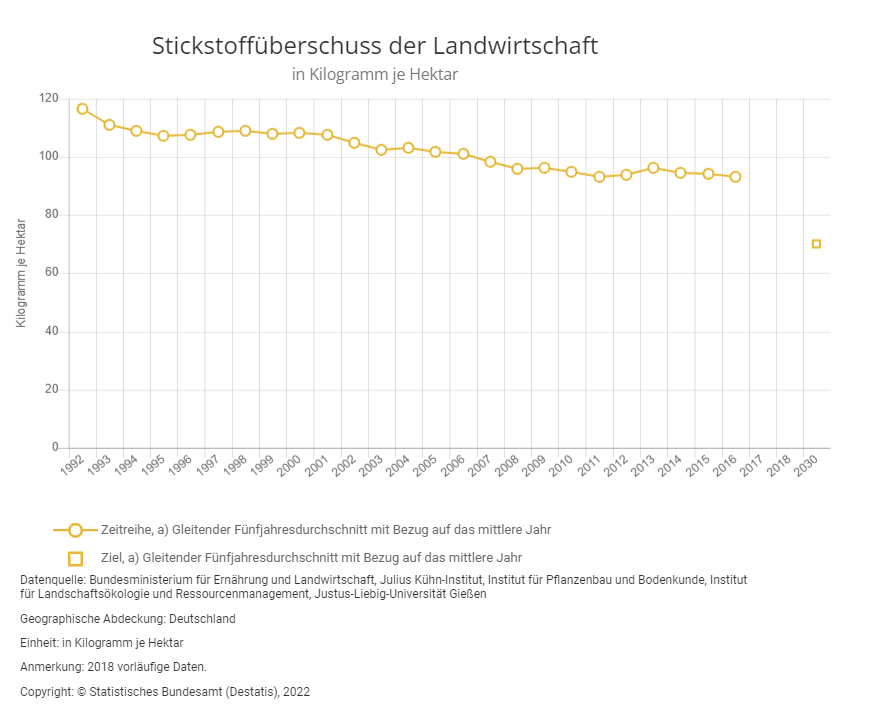
Excessive nitrogen discharged into the environment has numerous negative consequences for the environment. It pollutes groundwater and surface water, inland waters, oceans and terrestrial ecosystems are excessively supplied with nutrients, and greenhouse gases and air pollutants are produced. In an international comparison, Germany has a very high nitrogen surplus. The indicator is used by the German Sustainability Strategy (DNS). The indicator presented here and the data used are from DESTATIS from 2018.
-
The German government uses 70kg per hectare as the target value for this indicator. Many environmental experts consider this target value to be still significantly too high. Following the Federal Environment Agency's integrated strategy for reducing nitrogen emissions of 2009 and the special report of the German government's Council of Environmental Experts of January 2015, 2030Watch proposes a target value of 50 kilograms per hectare.
-
No exact baseline is defined. As a baseline for calculating progress, 2030Watch used the SDSN method to select the second-worst value in the EU country comparison from 2015.
-
This is an official indicator of the German Sustainability Strategy.