
How does Germany compare to other EU countries?
Further information on this indicator
-
This indicator shows the proportion of people in the total population who are considered materially deprived. Material deprivation describes the lack of certain consumer durables and the involuntary renunciation of selected consumption for financial reasons. Material deprivation applies to all people whose households meet at least three of nine specified criteria that reflect the household's financial constraints. Specifically, the nine characteristics include: not having a car, washing machine, color television, or telephone in the household (in each case, because the household cannot afford it financially); having a financial problem paying the rent, mortgage, or utility bills on time; heating the home adequately; eating meat, fish, or an equivalent vegetarian meal every other day; spending one week of vacation away from home each year; or meeting unexpected expenses of a certain amount (€1100 in 2019) from their own financial resources. The data comes from the harmonized Europe-wide survey "EU-SILC" (European Union Statistics on Income and Living Conditions), which is carried out in Germany by the Federal Statistical Office under the name "Living in Europe". Every year, around 14,000 private households in Germany provide information on income and living conditions on a voluntary basis.
-
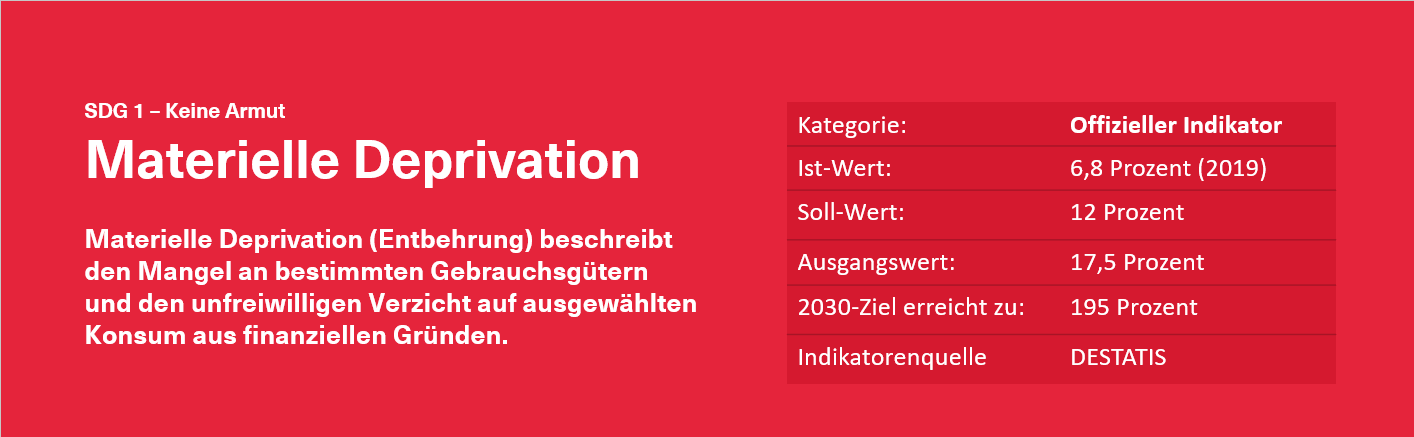
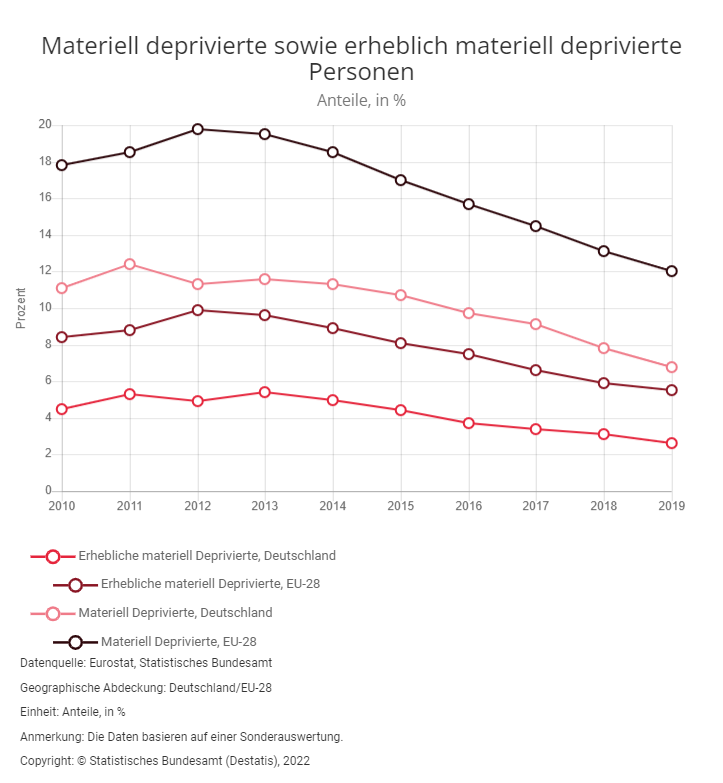
The German government has set itself the goal that the percentage of people who are materially deprived in Germany should be below the level of the EU-28. The average values for persons in the European Union are in each case significantly higher than the values for Germany. In 2016, for example, the proportion of the EU population (EU-28) that was materially deprived was 12% according to Eurostat estimates, significantly higher than Germany's figure of 6.8%. The EU-28 average from 2019 was taken as the target value for the progress calculation. 2030Watch has proposed a modified target value for this indicator, which is based on the official UN target under SDG 1 and calls for poverty to be halved according to national definitions.
-
The EU-27 average value from 2008 was chosen as the baseline (EU-28 value is not available for this year). For indicators without a set baseline value by the German Sustainability Strategy, 2030Watch is based on the 2008 baseline year of the EU 2020 Strategy.
-
This is an official indicator of the German sustainability strategy.